
Services

Voice Therapy
Dysphonia is any voice disorder that impacts vocal quality, pitch, loudness, or vocal effort. Voice disorders have many causes, including functional causes (yelling, excessive throat clearing, inefficient voice use), structural abnormalities (vocal nodules, cysts, polyps, inflammation, laryngeal trauma), neurologic diagnoses (Parkinsonism, multiple sclerosis, spasmodic dysphonia, recurrent laryngeal nerve paralysis), or other causes (chronic stress, conversion disorders). Singers and other professional voice users (actors, teachers, clergy, attorneys, receptionists, etc.) may experience a variety of voice difficulties due to the high demands placed on the voice.
Therapy may target:
voice quality (roughness, hoarseness, strain, breathiness)
pitch (too high, too low, pitch breaks, loss of range)
loudness (too loud, too soft, loss of range)
resonance
weak voice
vocal temor
running out of breath when speaking or singing
vocal fatigue (voice tires easily)
pain or tightness with voice use

Upper Airway Therapy
The primary function of the larynx is to act as a valve to protect the airway. Sometimes, this valve function becomes disordered.
Therapy may target:
chronic cough
chronic throat clearing
irritable larynx syndrome
laryngospasm
paradoxical vocal fold movement
exercise-induced laryngeal obstruction

Speech Therapy
A speech disorder refers to a problem with how an individual says sounds or words. Speech disorders can be developmental or acquired, affecting children and adults. In some cases, the cause is unknown; however, speech disorders are usually connected to conditions such as cerebral palsy, multiple sclerosis, muscular dystrophy, myasthenia gravis, Parkinson’s disease, dementia, stroke, or traumatic brain injury.
Therapy may target:
apraxia of speech
dysarthria (slurred speech, unclear speech)
dysfluency (stuttering or cluttering)
lisp
trouble with /r/

Swallow Therapy
Dysphagia is any swallowing disorder that impacts the oral cavity (mouth), pharynx (throat), or esophagus. Difficulty swallowing can affect hydration and nutritional status, lung health, and enjoyment of eating.
Therapy may target:
coughing/throat clearing during or after eating/drinking
wet or gurgly voice after eating/drinking
food or liquid leaking out of the mouth while eating/drinking
globus sensation (feels like food gets stuck)
pain with swallowing

SPEAK OUT!® Therapy Program for Parkinson’s Disease
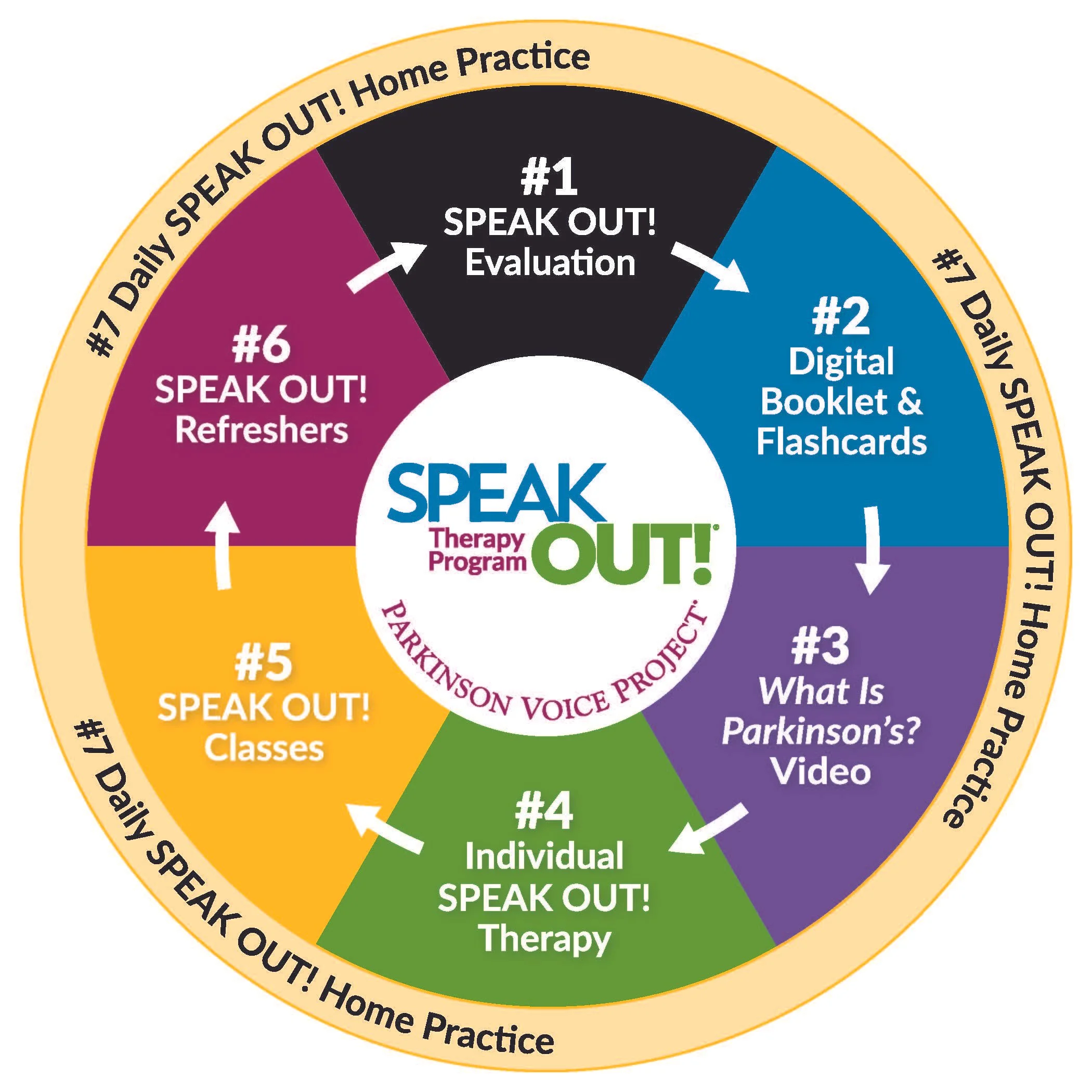
The SPEAK OUT!® Therapy Program, developed by the nonprofit organization, Parkinson Voice Project®, helps people with Parkinson’s and related disorders REGAIN and RETAIN their speech and swallowing. The program can improve volume, articulation, breath support for speech, vocal quality, intonation, and facial expression. Patients and families also report reduced drooling and improved swallowing. This highly effective, research-based treatment combines education, individual speech therapy, SPEAK OUT!® Classes, daily home practice, and continuous follow-ups. Patients are empowered to “speak with INTENT,” transitioning speech from an automatic function to an intentional act. The “Circle of INTENT” outlines the various therapy components and emphasizes that this program is lifelong.
SPEAK OUT!® Therapy Program at a glance:
Evaluation
Two individual therapy sessions per week for 4 weeks
SPEAK OUT!® Classes (group sessions) once a week
One individual therapy follow up 4-6 weeks later
Refreshers every 3-6 months

Singing Lessons
Develop healthy singing technique and prevent vocal injury.
Singing lessons are tailored to individual needs, but generally include:
warm-up exercises for healthy technique
application of technique to repertoire
performance coaching
Singing lessons are not considered therapeutic and cannot be billed to insurance.